The Heart Flow Method is a framework designed to help people reclaim their emotional sovereignty and build lasting, heart-to-heart connections.
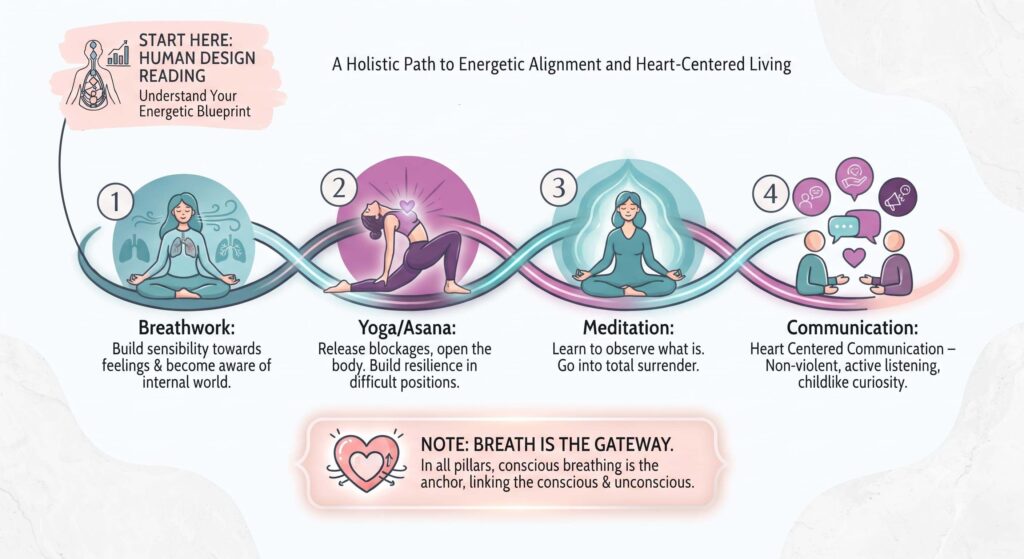
We begin at the root: Your Human Design.
By decoding your unique energetic blueprint, we establish a baseline for who you are, how you operate, and how you best interact with the world.
From there, we progress through four foundational pillars, with the breath serving as our constant gateway between the conscious and the unconscious:
1. Breathwork
We build the sensitivity required to identify your internal world. You will start to be able to observe the subtle sensations (and sometimes also strong ones) within, enabling you to experience any blockages on an embodied level.
Often we struggle with certain emotions when they overwhelm us in our day-to-day life. With the help of the breath, we can voluntarily and gently confront these parts of ourselves in a safe and controlled environment.
Working closely with the understanding of how the nervous system works gives us tools to process our experiences in an empowered way.If we learn how to become aware of our breathing in our daily life, we strengthen the ability to just observe and sit with our emotions, instead of blindly reacting to them. This will give us a feeling of confidence and autonomy.It is said that on average we take about 25,000 breaths per day, so imagine how much presence we can cultivate by paying closer attention to them.
2. Yoga & Asana
Here we learn to gain a better sensibility of our physical body. Where do we feel the tension, which positions are more challenging than others, and can I breathe deeper into them?
With a lot of gentleness and love toward the current state that we are currently at, we can slowly release physical blockages—not by force or comparison to others or external ideals, but rather by becoming "comfortably uncomfortable" in challenging positions. Therefore, we transform physical tension into emotional resilience, gaining confidence in ourselves by knowing that we can stay centered regardless of outer circumstances.
3. Meditation
Often this practice is marketed in the West as “free your mind,” “become calm,” or other pleasurable outcomes.
But the art of meditation lies rather in observing what is.
For everyone who has explored before with different techniques, you might have noticed that it is impossible “not to think about anything,” and that is also not the goal.
It is rather about building the capacity to first observe the mind, hear all that mental chatter, and not be caught up by it—hence, starting to detach from thoughts bit by bit.
In order to learn how to meditate, we first need to learn how to concentrate.
We cannot remove thoughts, but we can direct our focus to different sensations, objects of concentration, or the breath.
With different techniques, we can slowly learn how to work with the mind, instead of suppressing or judging it.
Remember, the mind is here to keep you safe, not to make you happy!
It is a slow journey, where at the beginning you might feel euphoria by breaking initial barriers, but can face, with time, challenges and frustrations, or even an apparent feeling of being stuck in your progression. This is very normal, and therefore an outside perspective can help you not to identify with any of it, but rather become curious and joyful about the exploration.
We don’t try to be Buddha or totally equanimous in every situation—we are still human, and we have the right to be carried away by emotions as well.
The important thing is to be aware of these mechanisms and be able to return to our center again and again, from which we can make aligned decisions.
We learn surrender, observation, and moving past our own resistance.
That results in a sense of presence that we might have only experienced spontaneously before, but now we have tools to get into these states voluntarily.
4. Heart-Centered Communication
After being aware of our breath, the tension or sensations in our bodies through yoga, and the ability of being present through regular meditation practice, we move on to learning how to express whatever goes on within us.
This is an essential part in order to build heartfelt connections with the people around us.
We are social beings who thrive on the support and love from our environment.
We all have feelings and needs that want to be appreciated and cared for.
When we get triggered, it’s hard to communicate clearly what is going on within us, leading to misunderstandings, tensions, and judgments that can impact, in the long run, a once beautiful relationship or friendship to a degree where we feel disconnected. And the further the emotional distance between the people we love the most, the more pain and frustration come with it.
With Heart-Centered Communication, we learn how to use conflict as a wonderful opportunity to deepen the connection.
Once this tension is resolved lovingly, we can feel how our heart is opening even more, and the love becomes stronger through that.
It’s just a matter of observation, humility, and the willingness to step away from the conviction of “being right.”
We integrate techniques strongly inspired by Non-Violent Communication (NVC) and active listening, encouraged by childlike curiosity - returning to a sense of wonder and exploration.
The result?
A being who is confident in embracing and expressing their own vulnerability as one of their biggest strengths.
Remember, if we are able to step into our sensitivity, we not only feel a freedom and self-love for who we truly are, but also provide the space for others to be their authentic selves.
And isn’t that what we are all longing for?
To be loved for who we are, beyond all the conditionings that we have experienced in our lives before.
Combined with the strength of building a massive library of all our emotions within, which we can move through without getting stuck in any of them, always returning back to our centers - well, that is the definition of freedom for me.
And this is what we use all these practices for: not to build another “spiritual identity,” but to become a being who feels free simply just to be!
If any of this resonates within yourself, then I would love to hear from you.
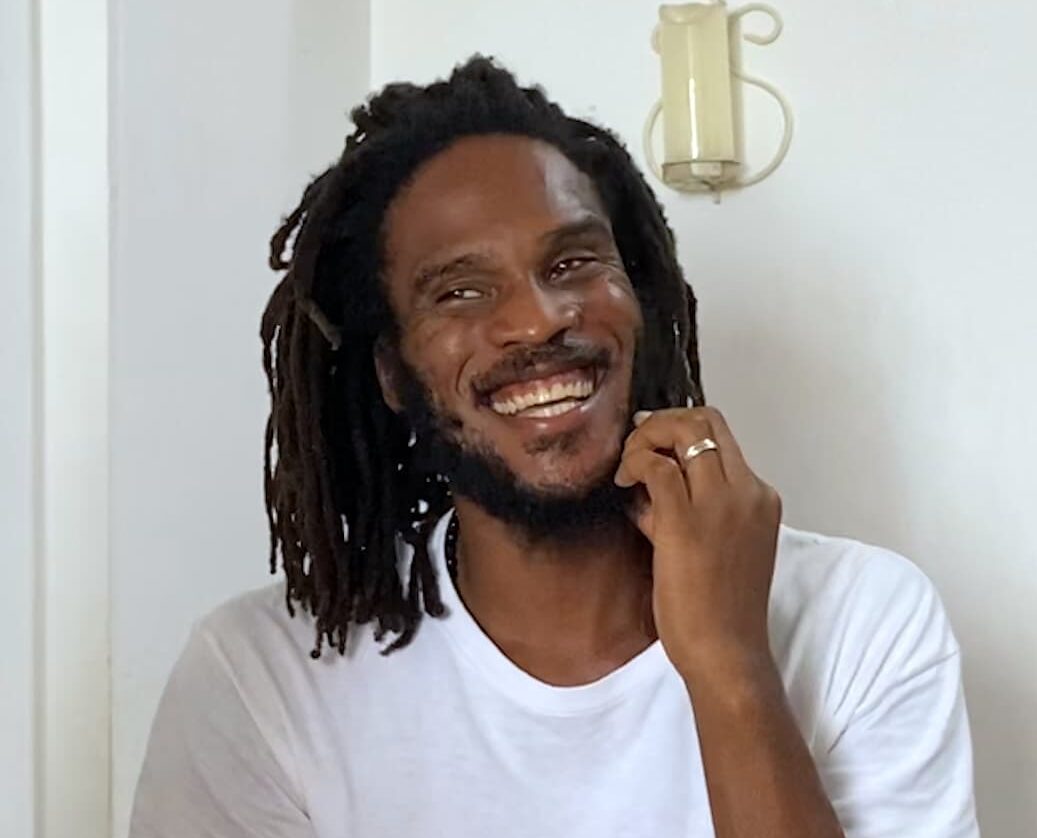
I met this beautiful soul in Amritapuri in Kerala (India). We immediately connected, first he coached me on NVC (non-violent communication) then I was honoured to be interviewed in his podcast.
Edgar has a wonderful heart, he has a natural inclination toward the lost art of communication. His commitment towards understanding the value of communication and seeing it as on of the tools to heal the world is truly commendable. And by communication I mean the true meaning of communication, where there is no judgement or manipulation, something that brings people together rather than separating them.
A"communication" that can be used as a tool to understanding ourselves and therefore understanding each other.
Thank you brother Edgar, for your journey 🙏 I am so happy that our paths have crossed. Keep shining, learning and sharing. The world needs it. Om 🙏
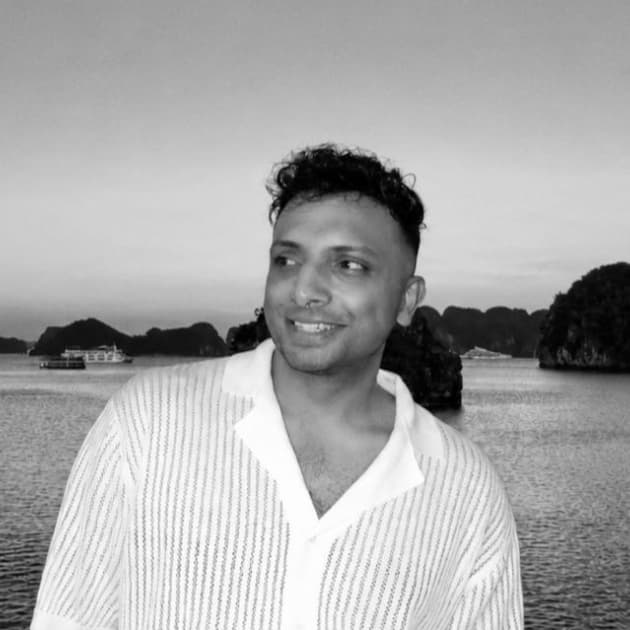
Thank you so much, Edgar, for your warmth and attentiveness during our session. The hours slipped away unnoticed because of the ease that you were able to bring to our conversation.
For a long time, communication has been a realm I wanted to explore more deeply and it has become a path of dharma I have also chosen to walk down in my life. But somehow it became even more enriching to delve into it with your guidance and wisdom. Feeling the intricacies of our emotions and feelings, understanding them, and then articulating them to the people who matter in our lives is truly an art form. You held our hands, guiding us closer to understanding how delicate it can be sometimes while also finding a sense of beauty within the process.
I am deeply grateful and I wish you the very best in your future voyages within this sphere and beyond!
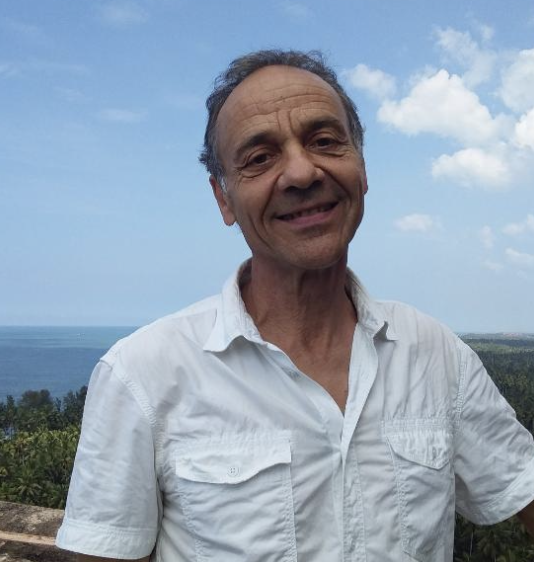
I have had the opportunity to benefit from Edgars delicate attention and seen the power of real compassion. I therefore encourage all those who would like to be supported in their openness and personal development to get closer to Edgar.